Text Message – Misrepresentation of Deposit Handling and Federal Fraud Indicators
Summary
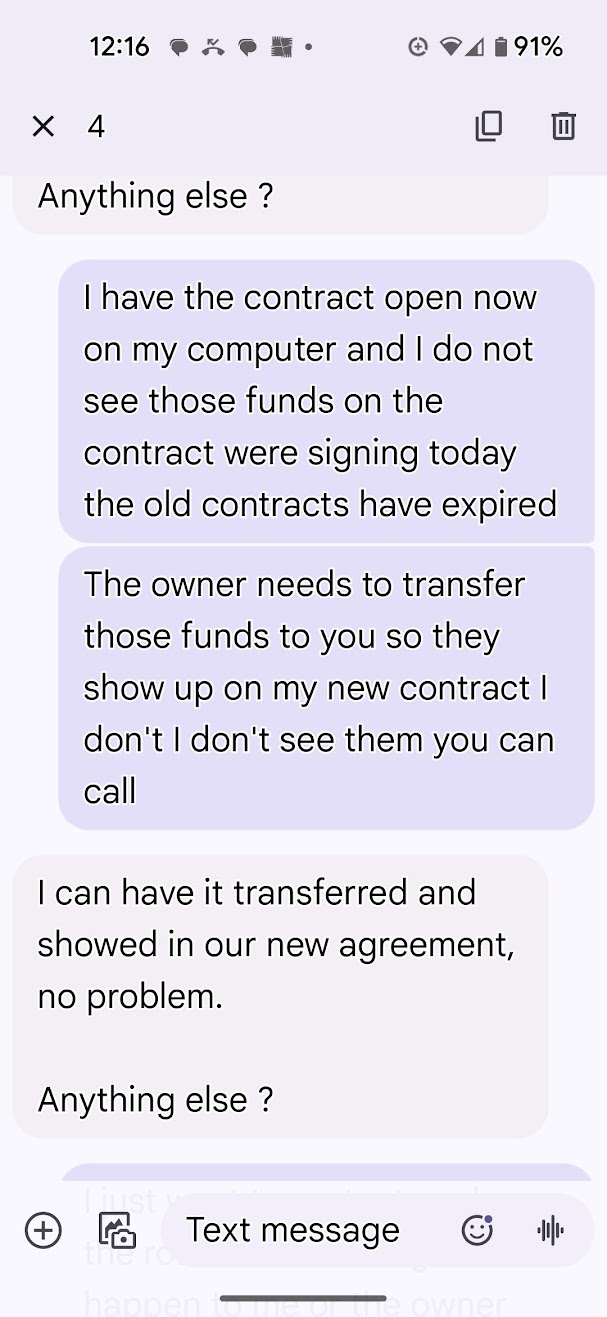
This exchange shows Michael Gasio notifying the property manager that the new contract did not include prior deposits totaling $7,350 ($6,000 security, $1,000 pet, $350 keys).
The manager falsely claimed, “I can have it transferred and showed in our new agreement, no problem,” despite no evidence that the deposit funds were ever transferred or credited.
This constitutes a false representation of a bank-controlled instrument and establishes a pattern of fraudulent inducement under state and federal law.
Legal Analysis
California Civil Code §1950.5(h) – Security deposits must be transferred or refunded when ownership or management changes. Failure to do so is conversion of tenant funds.
Business & Professions Code §10176(a) – A real estate licensee engaging in dishonest conduct, including false statements regarding trust funds, commits a disciplinary offense.
Penal Code §532 – Theft by false pretenses applies where misrepresentations induce continued tenancy or payment.
Federal Offense Indicators
18 U.S.C. §1343 – Wire Fraud: The agent used electronic communications (text and phone) to falsely represent that deposits were transferred.
This satisfies all elements: a scheme to defraud, intent to deceive, and use of interstate wire transmissions (SMS/bank systems).
18 U.S.C. §1344 – Bank Fraud: If the claim involved bank instruments (e.g., Wells Fargo accounts, cashier’s checks, or e-check transfers),
the misrepresentation constitutes fraud involving a federally insured financial institution.
Federal wire systems, text routing, and online banking are automatically considered interstate transmissions, giving the act federal jurisdiction.
Proof of Fraudulent Representation
A legally valid deposit transfer requires:
Written acknowledgment by both prior and new landlord or agent of deposit transfer and amount received.
Proof of physical fund movement—bank transfer, wire record, or escrow confirmation.
Updated ledger or receipt showing deposit credit under the new agreement.
Absent these, the agent’s text message constitutes false pretenses and misuse of a financial instrument.
The agent’s reassurance “no problem” created reliance and induced execution of a new, fraudulent contract, exposing both agent and owner to liability for wire fraud, bank fraud, and conversion of tenant trust funds.
Context and Implications
This exchange demonstrates a deliberate attempt to erase financial continuity between contracts.
By claiming a non-existent transfer of deposit funds, the property manager engaged in a pattern of electronic deception designed to create the false impression of compliance with California Civil Code §1950.5.
The use of bank-related instruments and communication networks elevates this conduct from civil violation to federal wire and bank fraud exposure.