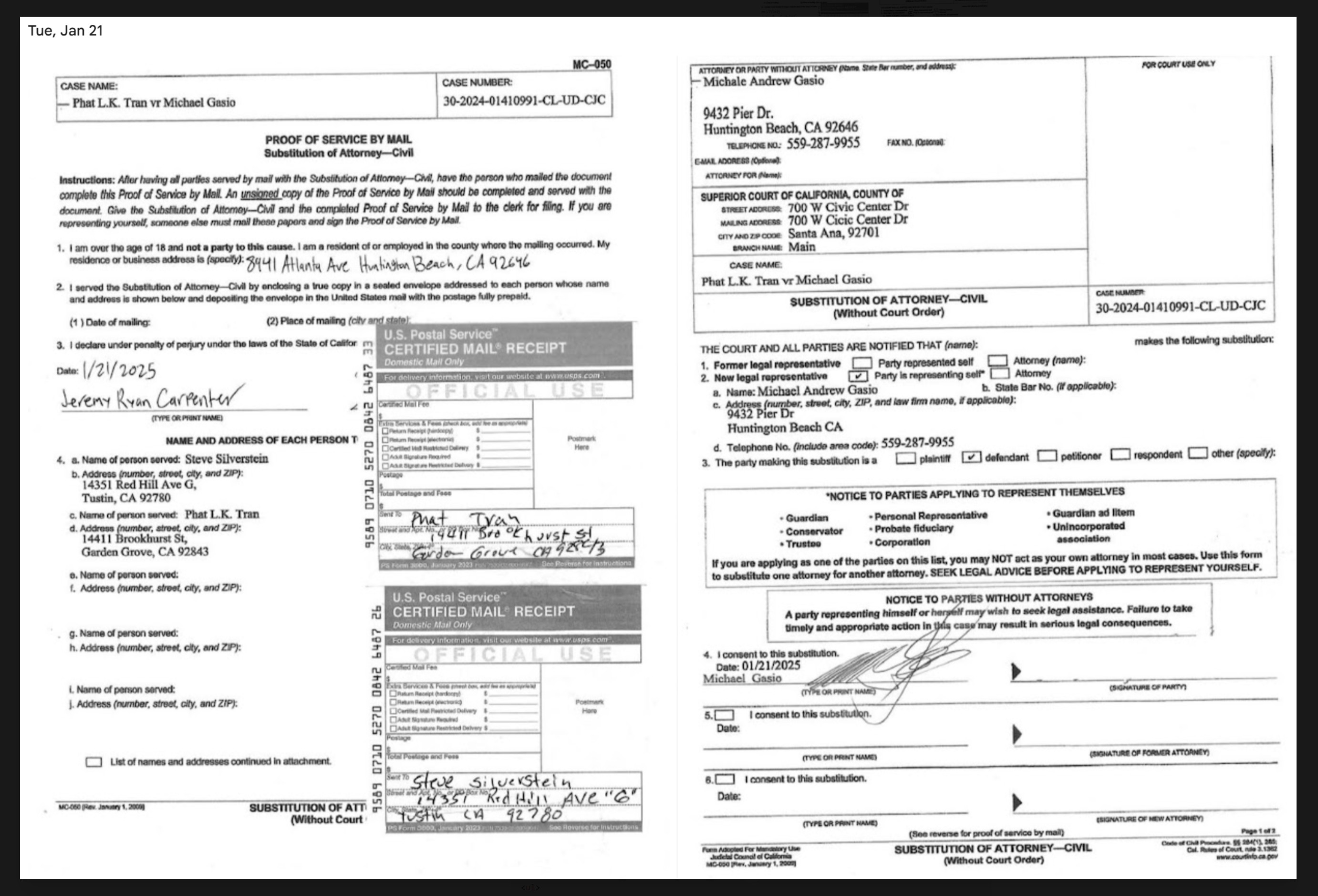
Filed January 21 2025 – Transition to Pro Se Status
This record documents the formal substitution of attorney and transition of Michael Gasio to self-representation in the case Phat L. K. Tran v. Michael Gasio (Case No. 30-2024-01410991-CL-UD-CJC, Orange County Superior Court). The attached filing (T33.png) includes the Substitution-of-Attorney form (MC-050), proof of service by certified mail, and supporting USPS receipts confirming service to all parties.
On Monday, January 20 2025, Michael Gasio appeared in court without counsel after attorney Rosiak’s withdrawal. Unfamiliar with courtroom procedure, he observed proceedings as the plaintiff’s substitute counsel, “Clint,” sought to continue the matter upon not seeing prior counsel present in the hallway. The next day, Gasio returned to court, sat in the hallway, and formally assumed responsibility for his own defense. Certified copies of the substitution notice were sent by courier with signature confirmation to Phat Tran, Berkshire Hathaway HomeServices, and Steven D. Silverstein, establishing full notice of the change in representation.
Legal Status of the Notice Procedural Requirement: The notice formally updates the opposing party and the court (if filed) about who is the proper contact for all future communications and service of process.
It is a necessary step to ensure that the case proceeds according to court rules.
No Special Privilege: The document itself isn't "privileged" in the sense of the attorney-client privilege, which protects confidential communications made for the purpose of seeking or rendering legal advice.
The content of the notice (the fact that you are now pro se) is a matter of public court record. Proof of Service: Using signature-required delivery (e.g., certified mail, courier) provides strong evidence that the opposing lawyer received the notice and was properly informed of the change.
This prevents them from later claiming they were unaware of the change in representation.
Response to Lawful Requests No "Legal Blindness": The plaintiff's lawyer cannot claim "legal blindness" to a properly served notice. Once served, they have a legal and ethical obligation to communicate with you directly as the self-represented party (rather than any former attorney, unless that attorney is still counsel of record for limited purposes).
Discovery Obligations Remain: All parties to a lawsuit, whether represented by counsel or pro se, are bound by the rules of civil procedure and discovery. Timelines and Deadlines: The formal notice of change in representation establishes the basis for future procedural timelines. For example, if you serve discovery requests, the opposing party generally has 30 days to respond (plus additional time if served by mail). Their obligation to respond is triggered by proper service of the discovery requests on you, the new party of record.
Failure to Respond: If the plaintiff's lawyer fails to respond to lawful discovery requests within the specified timeframe, the pro se litigant can file a motion to compel responses with the court after attempting to "meet and confer" (contacting them to resolve the issue informally first).
In summary, the written notice is a formal procedural document that demands acknowledgment and compliance with court rules from the opposing party. It ensures that you are treated as the proper litigant for all future correspondence and discovery, and opposing counsel cannot ignore their obligations to respond to your lawful requests.