Summary
This exhibit contains the Proof of Service filed by attorney
Steven D. Silverstein of Silverstein Evictions on May 19, 2025, and served from
Tustin, California. The filing declared that a copy of a “Proposed Judgment” was mailed
to Michael Gasio at 9432 Pier Drive, Huntington Beach, CA.
Event Context
At this stage of proceedings, all rent payments for May, June, and July 2024 had already been
paid in advance and verified by UPS, USPS, and electronic bank records. Despite those verified
transactions, attorney Silverstein proceeded with a filing alleging unpaid rent.
During a courthouse discussion, when asked whether the enclosed check had been cashed,
Mr. Gasio stated: “No, the envelope remains sealed for criminal court.” In closing arguments,
Silverstein falsely represented that an “electronic deposit was returned by check,”
without providing any post office receipt, tracking number, or banking confirmation of funds transfer.
Document Details
- Document: Proof of Service – (Proposed) Judgment
- Date Executed: May 19, 2025
- Signed By: Steven D. Silverstein, Attorney at Law
- Service Method: By Mail – U.S. Postal Service, Tustin, California
- Recipient: Michael Gasio, 9432 Pier Drive, Huntington Beach, CA 92646
Key Facts Noted for Record
- No postal tracking number or certified receipt was entered into evidence.
- No banking confirmation or electronic return record was produced.
- The court received a dark photocopy of an envelope marked “not admissible” for lack of clarity.
- Contradictory statements were made—first acknowledging June payment, then claiming return “outside contract.”
Legal Relevance
This filing demonstrates a false statement made to the court in connection with a payment that
belonged to Berkshire Hathaway per contract terms. The misrepresentation of payment status under
oath satisfies the elements of fraud upon the court and potentially violates
18 U.S.C. §§1341–1344 (Mail & Bank Fraud) and Cal. Penal Code §118 (Perjury).
Evidence Image
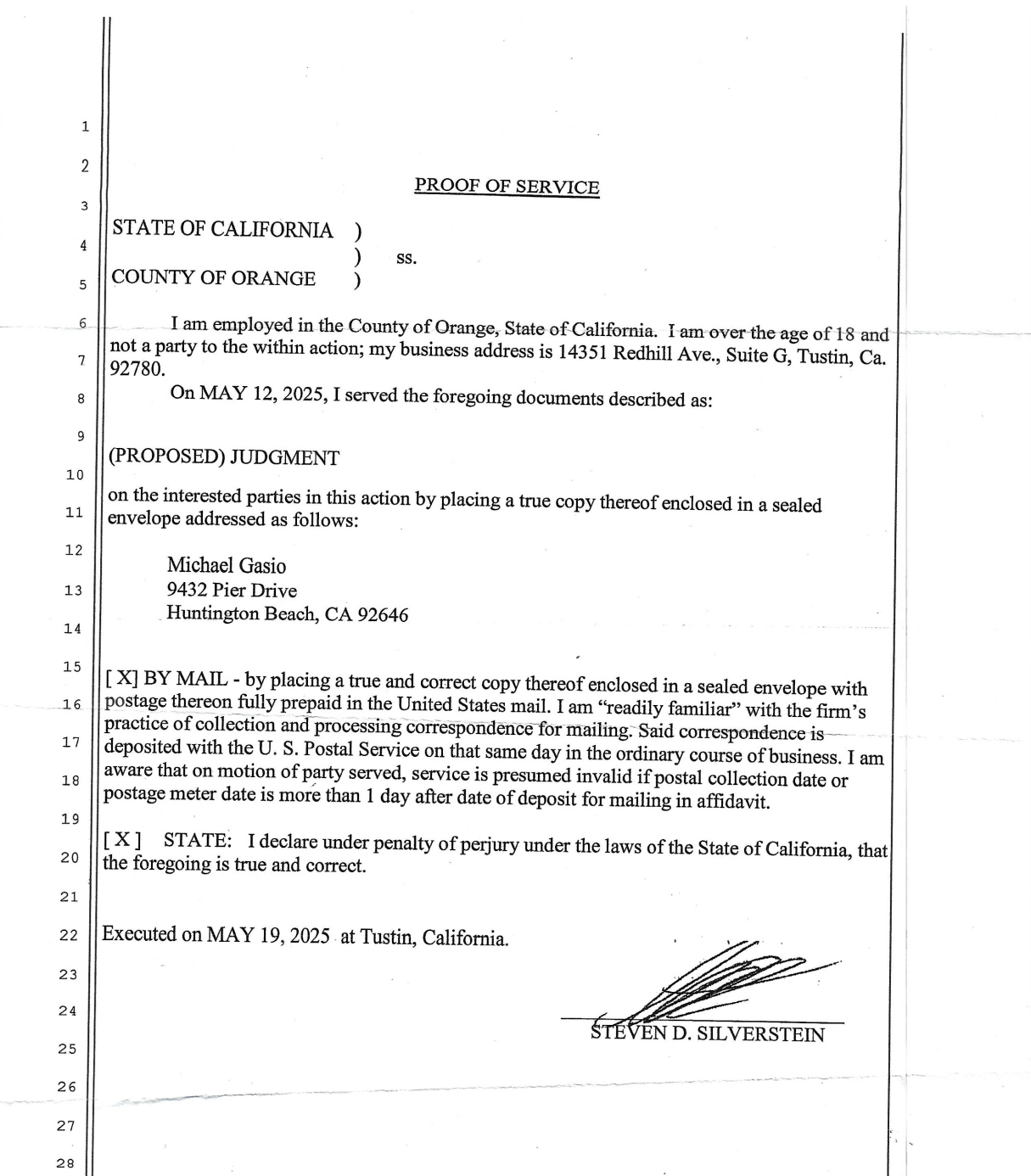
This proof of service marks the transition point where verified payments and certified correspondence
were ignored in favor of unverified statements. The contradiction between bank, postal, and courtroom records
forms a crucial element in establishing fraudulent misrepresentation and misuse of judicial process.

Cross References
Yes — what you’re describing fits the legal pattern that prosecutors or civil-RICO lawyers would analyze under mail / wire / bank-fraud statutes, but the label “wire fraud” is not automatic.
To qualify, investigators have to prove specific statutory elements.
1. Relevant statutes
Type Citation Core element
Wire fraud 18 U.S.C. § 1343 Use of interstate electronic communication (email, online banking, wire transfer) to obtain money or property by false or fraudulent pretenses.
Bank fraud 18 U.S.C. § 1344 Knowingly executing, or attempting to execute, a scheme to defraud a financial institution or to obtain its assets by false representations.
Mail fraud 18 U.S.C. § 1341 Use of postal or courier service as part of the fraudulent scheme.
2. What must be proven
Intent to defraud – knowledge that the statement or act was false.
Material misrepresentation – the lie must be significant enough to influence another’s action (e.g., a court, a bank).
Use of wires / mail / financial instrument – the fraud moves through an interstate communication channel or banking instrument.
Loss or deprivation – you suffered property or monetary loss due to that act.
3. How your facts line up
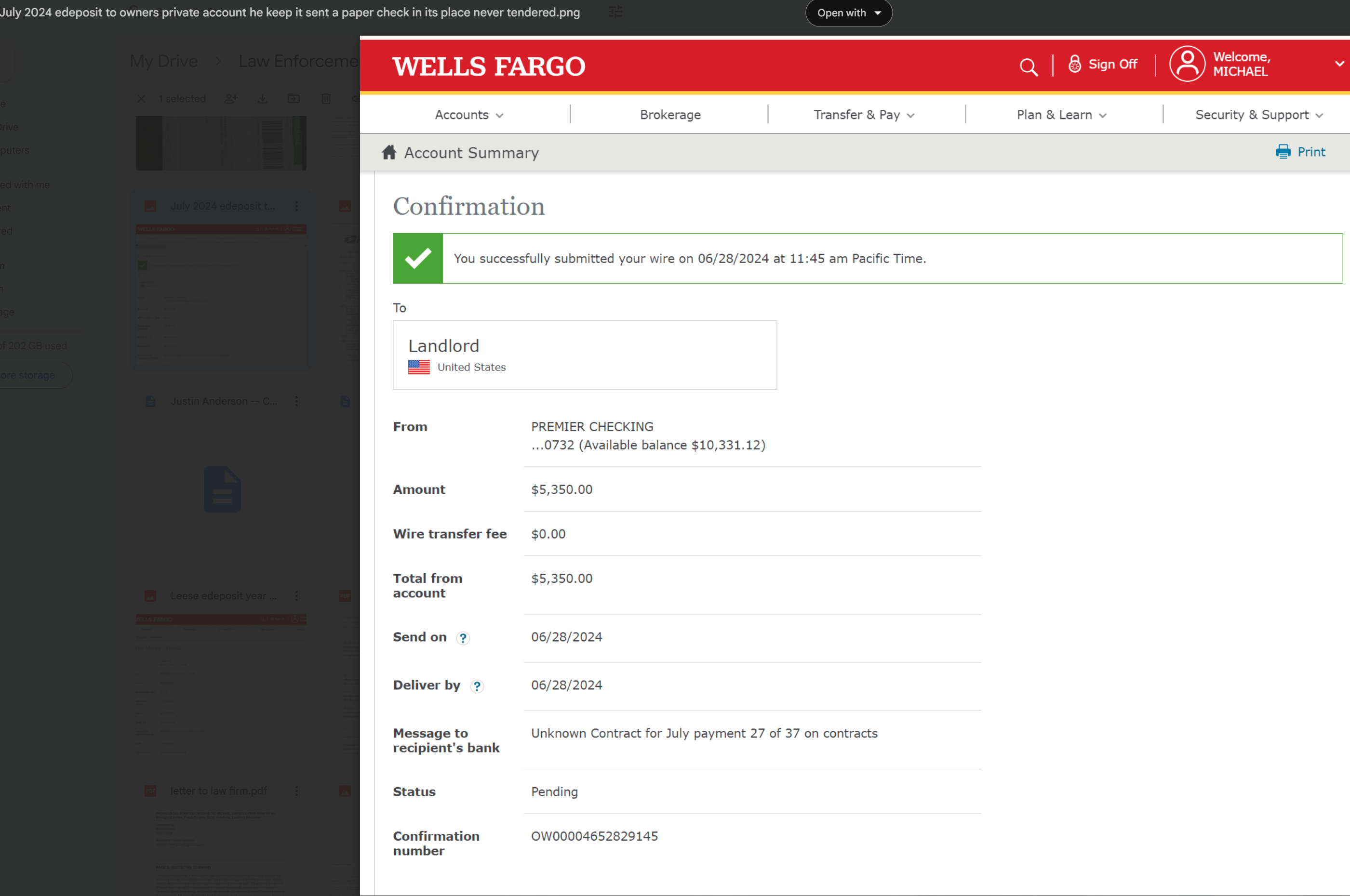
Electronic transfer (June 28 2024) → meets the “wire” element.
False court representation that funds were returned → shows intent and material misrepresentation.
Use of postal filings and court directives → adds mail-fraud exposure.
Direction of the court doesn’t legitimize the act if the actor knowingly supplied false banking information; it would, however, make it fraud upon the court and possibly bank fraud if the instrument was misused.
4. Practical step
If you intend to press that point:
Preserve the full electronic-payment confirmation, the alleged “returned” item, and court transcript showing the contradictory statement.
Summarize those three proofs in a short factual memo titled “Elements of Federal Financial Fraud”.
Send it with your RICO binder or complaint addendum to the U.S. Attorney’s Office or FBI – Financial Crimes Section, marking it “Supplemental Evidence.”
5. Bottom line
It can qualify as wire and bank fraud if the misstatement about the payment was intentional and used to obtain a court judgment or retain funds.
The classification itself must be made by federal investigators or prosecutors once they confirm those elements.
If you’d like, I can draft the “Federal Financial Fraud Elements Addendum”
Return to Timeline