Overview
This page documents the full scope of evidence suppression by every individual and corporate respondent
involved in the case of Tran v. Gasio. Under California law, parties involved in litigation
have a legal duty to preserve, retain, and return material evidence and documents belonging to a litigant
once litigation is reasonably foreseeable. This duty exists regardless of whether the individual is an attorney,
corporate agent, property owner, broker, or representative.
Acting pro se, the tenant lawfully demanded the return of all critical documents and placed
HBPD Lt. Randall on CC as an official custodian of record to ensure proper chain-of-custody
and to confirm whether any party would comply.
Every respondent failed to produce required documents, constituting clear indicators of concealment and obstruction.
This expanded section provides legal foundations, detailed actor-specific findings, consequences of suppression,
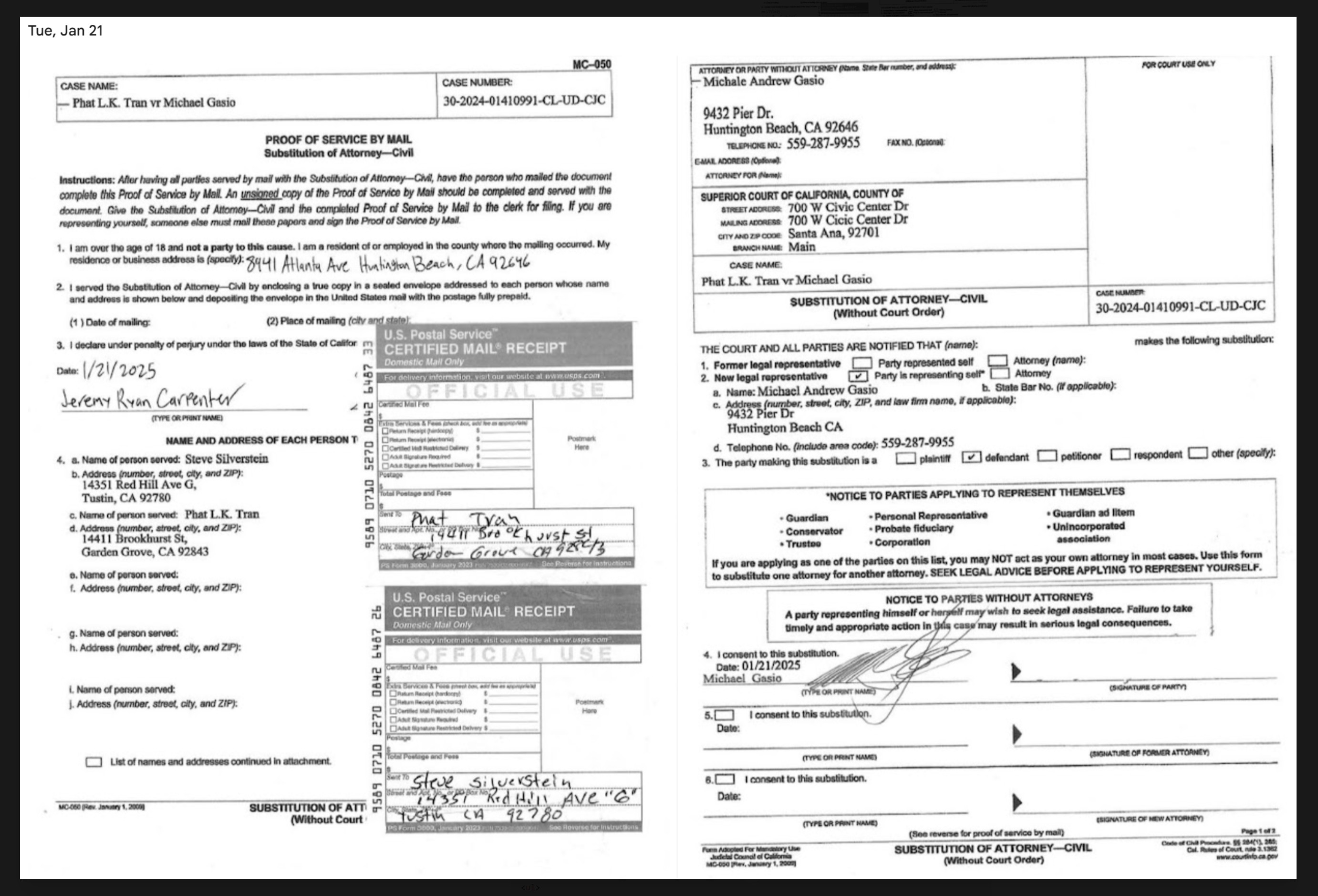
and large-format exhibits correlating to the certified mail and evidence-return demands.
Actor-Specific Findings (Expanded)
1. Steven Silverstein — Eviction Attorney
Silverstein was obligated to retain all correspondence, notices, filings, and payment records related to the unlawful detainer
action. Multiple certified demands were served, yet he returned nothing. As the attorney who filed the eviction, his records
were essential to verifying service, payment history, and representations made to the court. His refusal constitutes:
- Suppression of tenant defense materials
- Possible destruction of exculpatory evidence
- Bad-faith litigation tactics
2. Richard Rosiak — Former Tenant Attorney
Rosiak was required to return the complete client file, including emails, contracts, payment records, and all evidence
provided by the tenant. Despite formal demands, he did not produce a single document. This violated Rule 1.16(e) and
materially harmed the tenant’s defense by denying access to critical evidence. His refusal appeared intentional and
aligned with the timing of his withdrawal.
3. David Beard — Berkshire Hathaway Legal
As corporate counsel, Beard had a statutory duty to preserve all documents related to the allegations of fraud presented to
him. He was given explicit notice of contract tampering, payment concealment, and document fraud. His complete failure to
respond or return documents suggests intentional suppression.
4. Martha Mosier — Corporate Executive
Mosier received extensive evidence, including full binders sent by certified mail. As a corporate officer, she was required
to escalate and preserve such materials. Her failure to produce even a single page demonstrates either deliberate suppression
or gross negligence in corporate retention protocols.
5. Phat Tran — Property Owner
Tran was formally served and notified of his obligation to provide the original lease, renewal agreements, receipts,
communication logs, and agent correspondence. He refused to produce any documents—including the very contract he relied
upon to evict the tenant—indicating concealment and obstruction.
6. Hanson Le — Real Estate Agent
Le received all notices and was personally involved with receiving mailed payments addressed to the brokerage. He was
in possession of material evidence, including the tenant’s check and renewal correspondence. His failure to produce
these items, combined with invoking the Fifth Amendment when questioned by police, strongly suggests intentional concealment.
7. Anna Ly — Listing Agent
Ly handled the original listing, the 2022 lease, the 2023–2024 renewal, and multiple disclosures. She was legally required
to produce those documents when notified. Instead, she deleted inbox content and denied sending contracts that appear in your
records. Her refusal supports allegations of contract fraud and evidence destruction.
8. Jeremy Ryan Carpenter — Mail Handler
Carpenter’s records show that certified mail was properly processed and that all respondents received formal notice.
His documentation confirms that you used appropriate legal channels to demand evidence. His compliance highlights the
non-compliance of all other parties.