Evidence Cards — Large Format with Full-Size Links
Open full-size Sand Dune Lane ownership map
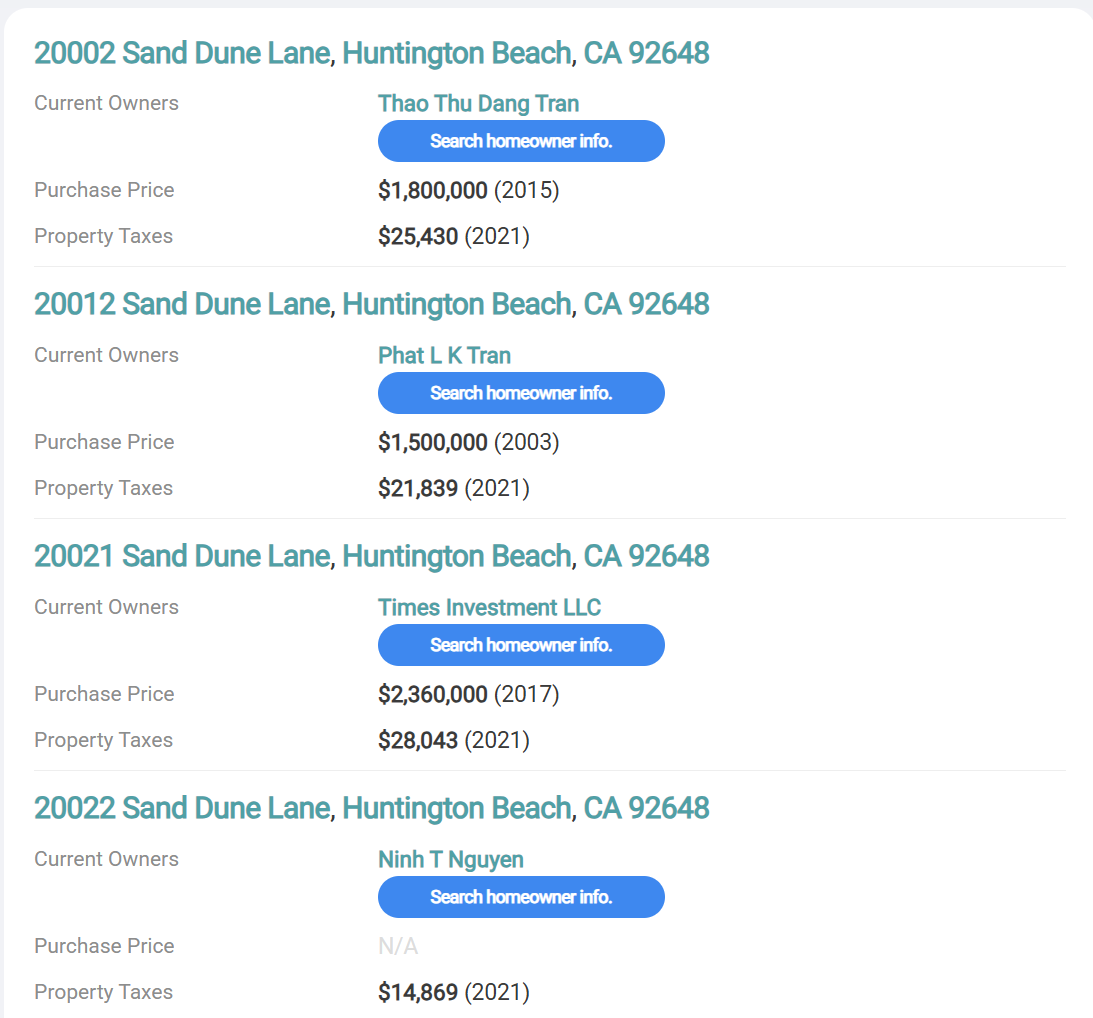
Sand Dune Lane property cluster showing:
• 20012 Sand Dune Lane — owned by Phat L. K. Tran (your landlord)
• 20002 Sand Dune Lane — owned by Thao Thu Dang Tran
• 20021 Sand Dune Lane — owned by Times Investment LLC, a Tran-linked entity
• 20022 Sand Dune Lane — owned by Ninh T. Nguyen, another surname tied into the Tran network
This mapping reveals a tightly controlled block of properties connected to the same family network, strongly suggesting centralized control and shared financial interests.
• 20012 Sand Dune Lane — owned by Phat L. K. Tran (your landlord)
• 20002 Sand Dune Lane — owned by Thao Thu Dang Tran
• 20021 Sand Dune Lane — owned by Times Investment LLC, a Tran-linked entity
• 20022 Sand Dune Lane — owned by Ninh T. Nguyen, another surname tied into the Tran network
This mapping reveals a tightly controlled block of properties connected to the same family network, strongly suggesting centralized control and shared financial interests.
Open full-size Tran family-tree cluster
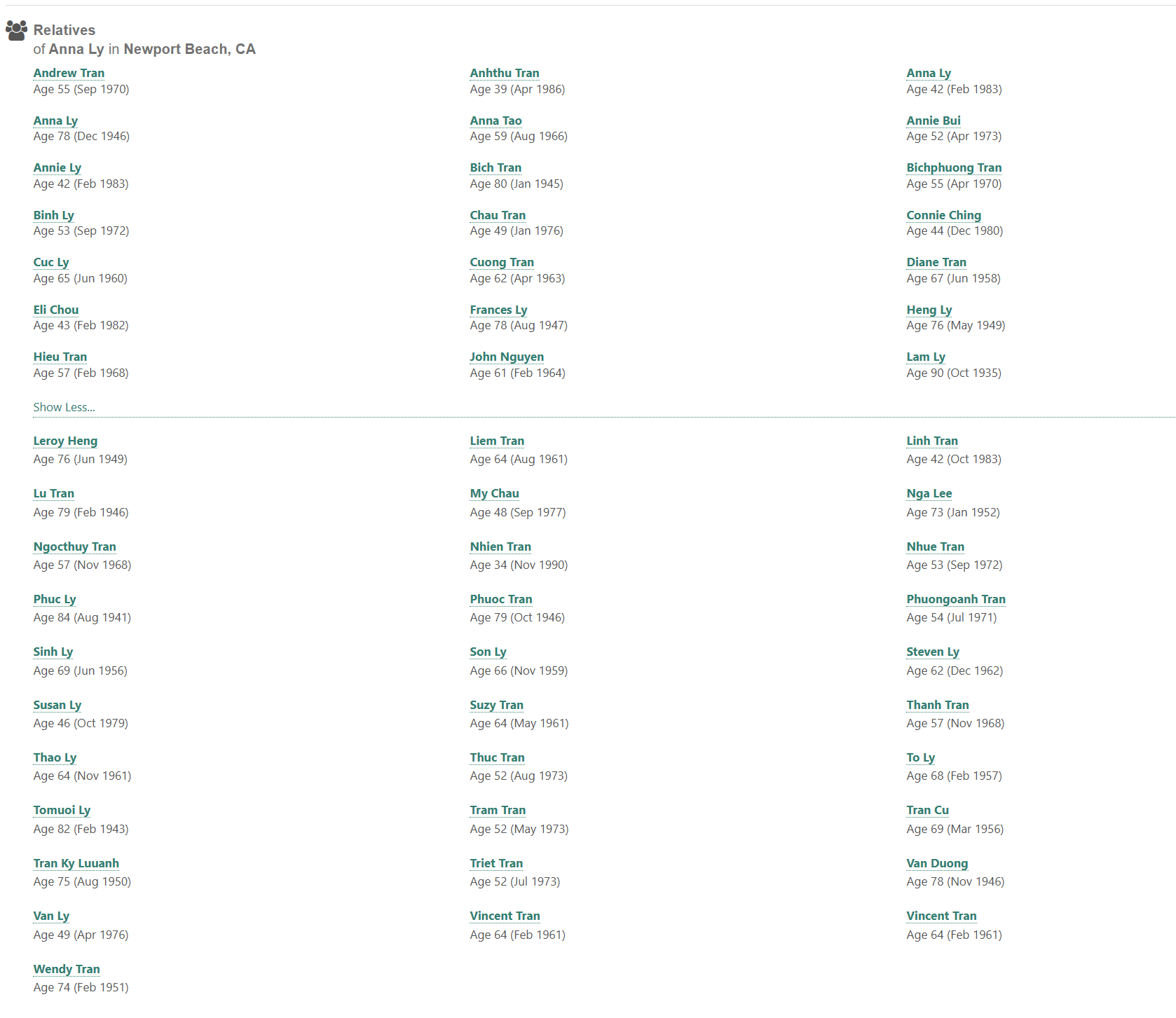
The extended Tran-family relational map showing dozens of individuals across generations, including:
• Multiple individuals named Tran connected to Anna Ly via surname variants
• Common naming patterns such as Lan Tran, Liem Tran, Thanh Tran, Vincent Tran, etc.
• Overlaps of aliases and alternate spellings from DA50’s alias matrix
This tree illustrates how Anna Ly fits into the broader Tran familial network, supporting theories of coordinated real-estate activity and shared enterprise liability.
• Multiple individuals named Tran connected to Anna Ly via surname variants
• Common naming patterns such as Lan Tran, Liem Tran, Thanh Tran, Vincent Tran, etc.
• Overlaps of aliases and alternate spellings from DA50’s alias matrix
This tree illustrates how Anna Ly fits into the broader Tran familial network, supporting theories of coordinated real-estate activity and shared enterprise liability.